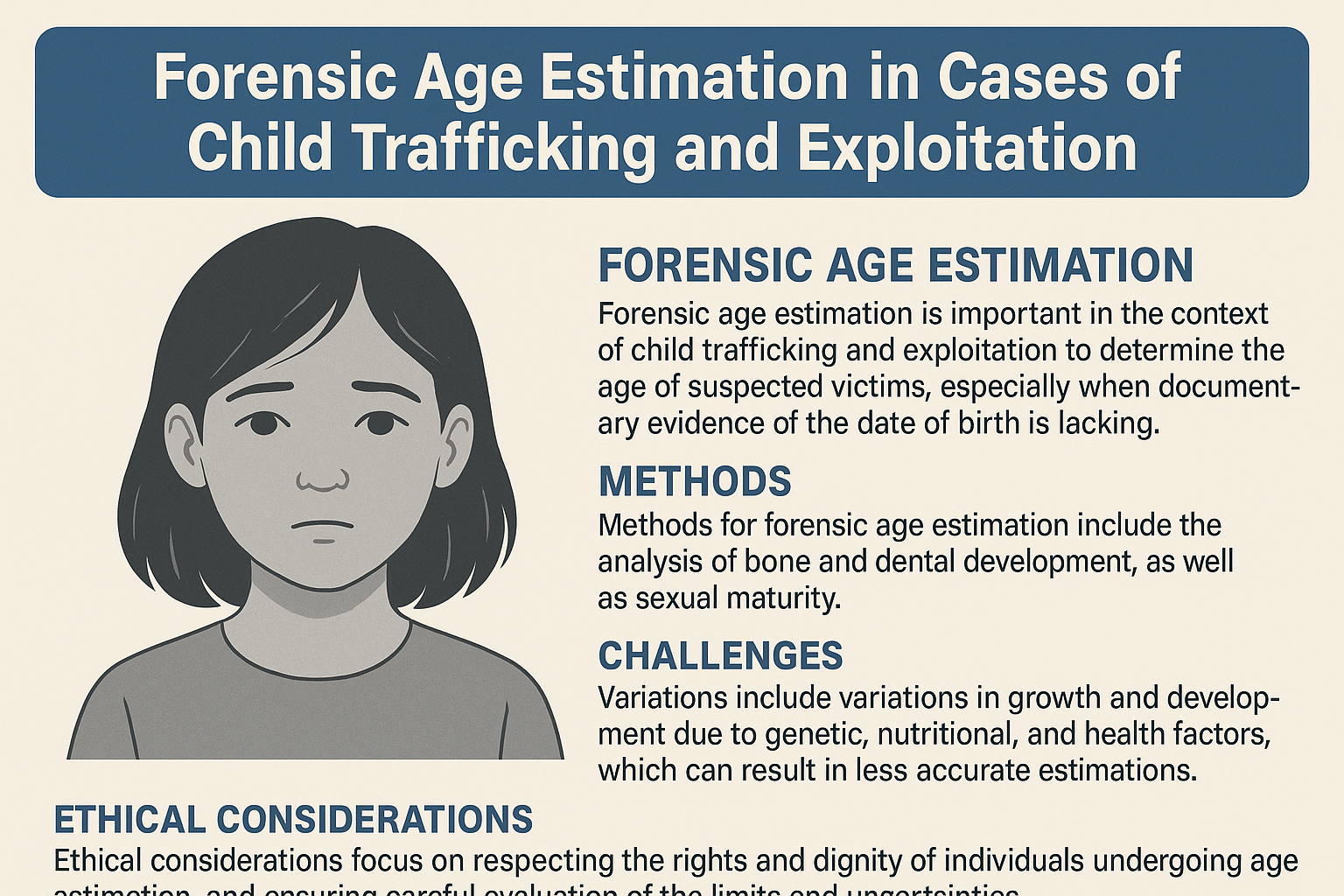
Forensic Age Estimation in Cases of Child Trafficking and Exploitation
INTRODUCTION
Child labour has been acknowledged in international & national legal frameworks as a practice that deprives children of their fundamental rights, including the right to childhood, education, and holistic physical, social, and moral development. Despite extensive legal frameworks, the ratio of child labour remains high in low-income countries 19% of children are engaged in labour, compared to about 1% in high-income countries. The Global Estimates of Modern Slavery further indicate that nearly 4.3 million children are subjected to forced labour. Article 24 of the Constitution of India prohibits the employment of children below the age of fourteen years in any factory, mine, or other hazardous employment. The individuals who have attained the age of fourteen years may be employed, and such employment must be confined to non-hazardous occupations.
Forensic age estimation refers to the scientific process of determining an individual’s chronological age when the documentary proof is absent or unreliable. It is crucial in cases of child trafficking, child labour, sexual exploitation, adoption fraud, and immigration offences, where establishing whether the victim is a minor directly affects legal protections, criminal charges, and sentencing.
Age Estimation Is Important in Trafficking and Exploitation Cases
Because it helps determine whether the refugees and asylum seekers are adults or children. This is necessary because adults and children are subject to different legal rules and procedures. The United Nations High Commissioner for Refugees (UNHCR) reports that half of all people forced to leave their homes are children. These children are especially vulnerable to abuse, neglect, violence, exploitation, trafficking, or even forced recruitment into armed groups, which makes them in need of strong international protection.
The Convention on the Rights of the Child states that child under 18 years must be given their rights without any discrimination. However, problems often arise when individuals claiming to be children lack proper identification documents to verify their age. In such situations, accurately estimating their age becomes crucial.
1. It determines whether the victim is a child or not
According to international law (UNCRC) and Indian national law, anyone under the age of 18 years is deemed a child.
2. It ensures the application of child laws made for different purposes
- POCSO Act, 2012
- Juvenile Justice (Care and Protection of Children) Act, 2015
- Child Labour (Prohibition and Regulation) Act
- Immoral Traffic (Prevention) Act
- Bonded Labour System (Abolition) Act
3. It protects victims from criminalisation
The Children trafficked for prostitution or labour are victims, not offenders.
4. Also determines punishment for traffickers
The trafficking of minors carries higher penalties and punishment.
Methods for Forensic Age Estimation
1. Documentary Evidence (Primary Method)
- Courts prefer documentary proof first:
- Birth certificate
- School records
- Aadhaar (limited reliability)
- Hospital birth records
- Under the JJ Act (Rule 12), documentary records have priority over medical tests.
2. Medical / Biological Examination
If documents are absent, forged, or doubtful.
A. Physical Examination
- Height, weight, puberty signs (Tanner stages)
- Dental eruption patterns
- Not highly accurate, but provides a preliminary estimate.
B. Dental Age Assessment
- Most reliable non-invasive method.
- Techniques include:
- Demirjian’s Method: Demirjian’s Method is a way to estimate a person’s age by looking at how their teeth have grown in an X-ray.
- Moorrees, Fanning & Hunt method: It is a method of estimating age by studying the different stages of tooth growth and development using dental X-rays.
- Uses more detailed stages (14–20 stages) of tooth formation and root growth.
- Wisdom tooth (third molar) development in late adolescence
- Dental X-rays are widely used.
(It means estimating a person’s age by looking at how the wisdom tooth grows and forms in a dental X-ray, especially during the teenage years.)
C. Skeletal (Bone) Age Assessment
- Uses radiographs to compare bone development with standard atlases.
- Common methods:
- Greulich and Pyle Atlas (A method that estimates age by comparing a child’s hand–wrist X-ray to standard pictures in an atlas.)
- Tanner–Whitehouse (TW2/TW3) A method that estimates age by scoring the growth of each bone in the hand–wrist X-ray.
- Clavicle CT/MRI for the 16–21-year age group
- Bone age helps in late adolescence, where key growth plates fuse.
(A method that checks how the collarbone (clavicle) is developing using CT or MRI to estimate age in older teenagers.)
D. Other Advanced Techniques
- Used in certain jurisdictions:
- MRI of the knee or clavicle
- CT scans for ossification
- DNA methylation age markers (emerging research)
- Legal Framework in India
1. Juvenile Justice Act (Section 94)
- Prioritises:
- School certificate →
- Birth certificate →
- Age estimation through medical tests
2. POCSO Act
Any doubt about age must favour the child.
3. Supreme Court & High Court Guidelines
- Medical tests are only conducted when documents are unavailable or suspicious.
- Age cannot be determined solely by physical appearance.
- Importance of Forensic Age Estimation in Trafficking Cases
1. Identification of Child Victims
Many trafficked children lack documentation; age estimation becomes essential for the rescue, protection, and rehabilitation of the child.
2. Determining Type of Offence
- If the victim’s age is below 18, offences automatically become:
- Aggravated trafficking
- Aggravated sexual assault under POCSO
- Stricter punishment under ITPA
3. Preventing Misclassification
- Adult victims may sometimes be misclassified as minors or vice versa; forensic methods reduce such errors.
4. Protection During Proceedings
- Ensures child-friendly procedures
- Ensures placement in appropriate homes (Child Care Institutions)
- Ethical Considerations
- Respecting the child’s dignity
- Avoiding intrusive procedures
- Minimising radiation exposure
- Informed assent and consent
- Gender-sensitive examinations
- Avoiding re-traumatisation of victims
Relevant Case Laws
Jarnail Singh v. State of Haryana (2013)
The Supreme Court held that the age determination rules used for juveniles (children in conflict with the law) must also be used for child victims, including victims of trafficking and sexual offences.
Key Points of the Judgment
1. Rule 12 of JJ Rules applies to child victims
Earlier, Rule 12 of the Juvenile Justice Rules was applied only to accused claiming to be juveniles.
In this case, the Supreme Court said the same rule must also be used to find the age of a child victim.
2. Priority of documents over medical tests
The Court laid down the order for age determination:
School certificate (first preference)
Birth certificate
Medical tests (ossification/dental) – used only if documents are not available or unreliable.
3. The benefit of the doubt goes to the child
If age is uncertain, the court must treat the person as a minor.
4. Importance of POCSO and trafficking
After this judgment, courts apply strict child-protection laws if the victim is found to be under the age of 18.
Jarnail Singh v. State of Haryana (2013) held that the JJ Rules for age determination apply equally to child victims, giving priority to documentary evidence over medical tests.
Babloo Pasi v. State of Jharkhand (2008)
Held that ossification and medical tests provide only an approximate age and cannot override reliable documentary evidence.
Medical tests are used only when documents are doubtful
If documents are missing, fake, or unreliable, then medical tests can be used as supportive evidence, not as the only basis.
Margins of error
The Court acknowledged that medical age estimation has a margin of error of 2–3 years.
Sunil v. State of Haryana (2010)
The Supreme Court held that when different medical age reports give different results, the court must choose the opinion that is more favourable to the accused or the child, depending on the context.
The benefit of the doubt
Because medical tests are not 100% accurate, the court must give the benefit of the doubt.
Important in minor-related cases
This judgment is often used in Juvenile justice, trafficking, child labour, POCSO and sexual offences
Court on its Own Motion v. State (Delhi High Court, 2013)
This case laid down important guidelines for how the police, Child Welfare Committees, and courts must identify, protect, and determine the age of trafficked and missing children.
Key Points
1. Age determination must follow JJ Rules
The Court held that age determination should strictly follow the JJ Act procedure, meaning:
School certificate
Birth certificate
Medical age tests (only if documents are missing)
2. Mandatory age verification for rescued children
In cases of:
child trafficking,
child labour,
prostitution,
missing children,
The authorities must immediately assess age using proper legal guidelines.
3. Protection of the child during investigation
The Court instructed:
Children must not be treated as offenders.
They must be produced before the Child Welfare Committee (CWC).
They must receive counselling, medical care, and a safe place.
4. Police must follow child-friendly procedures
- The High Court instructed that police must:
- Record statements in a sensitive way
- Avoid harsh interrogation
- Ensure the presence of a trusted adult or social worker
5. Trafficked children must be treated as victims
The Court draws attention to the fact that a trafficked or exploited child is always a victim, not a criminal. It ensures protection under the JJ Act, POCSO, and ITPA.
Conclusion
Forensic age estimation plays a crucial role in child protection, especially in cases of trafficking and exploitation. Documentary evidence, medical checkups, and forensic techniques ensure justice for victims and enable the courts to apply laws framed for children. The guiding principle is always to favour the protection, dignity, and rights of the child. The child involved in trafficking is deemed to be treated as a victim, not as a criminal. Several case laws, guidelines and legal frameworks have been developed so far for related issues.
By:
Umar Ali, 4th year (B.A.LL.B. Hons)
Department of Law, Barkatullah University, Bhopal (M.P.)
Reference
Acts / Rules / Government Documents
Juvenile Justice (Care and Protection of Children) Act, 2015, Government of India.
Protection of Children from Sexual Offences (POCSO) Act, 2012, Government of India.
Immoral Traffic (Prevention) Act, 1956, Government of India.
UN Convention on the Rights of the Child (UNCRC), 1989.
Model Guidelines under Section 39 of the JJ Act, Ministry of Women and Child Development, Government of India.
Web / Reports
National Crime Records Bureau (NCRB). Crime in India Report.
Ministry of Women and Child Development.
Trafficking in Persons Report, Government of India.
Books
Parikh, C.K. Parikh’s Textbook of Medical Jurisprudence and Toxicology. CBS Publishers, New Delhi.
Saukko, Pekka & Knight, Bernard. Knight’s Forensic Pathology. CRC Press.
White, Susan & Folk, Jeffrey. Forensic Anthropology: An Introduction. Routledge.
UNICEF. Child Protection and the Juvenile Justice System in India. UNICEF Publications.
