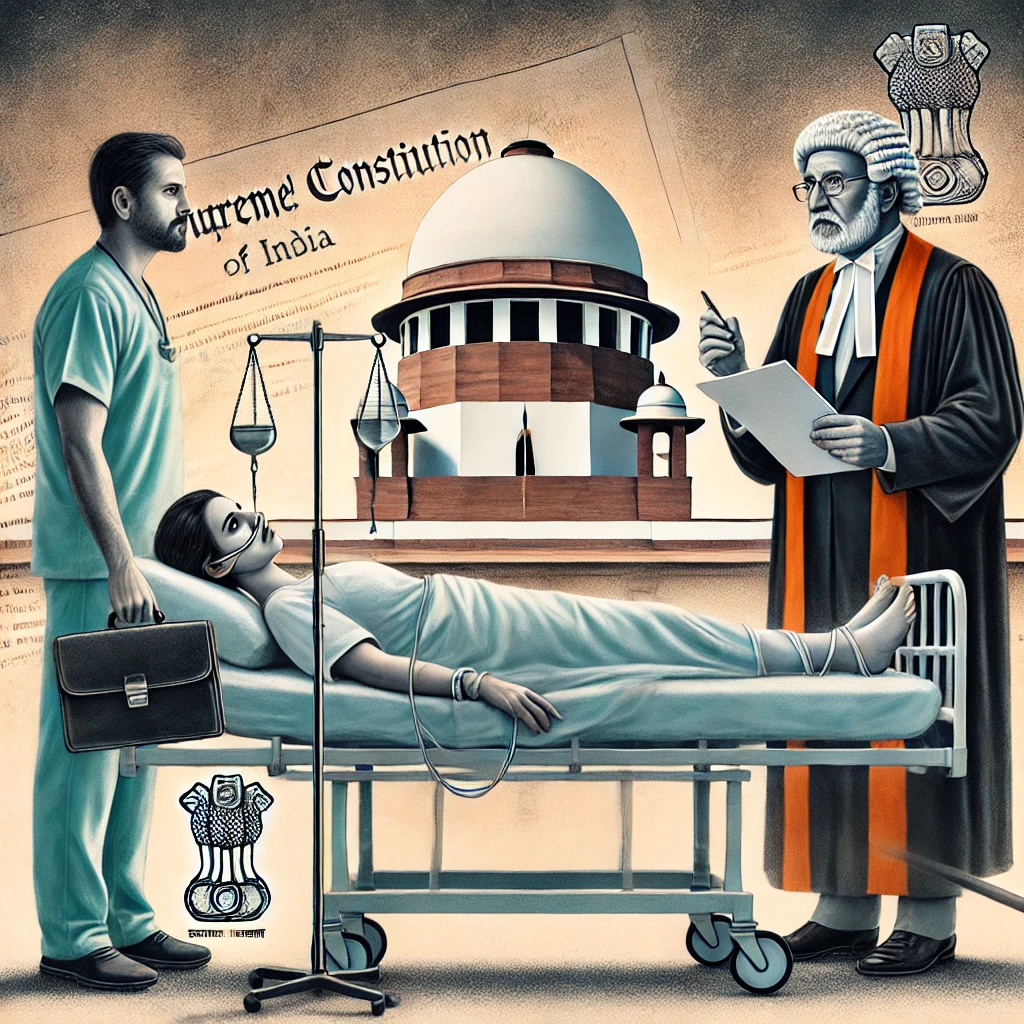
Euthanasia and the Indian Legal System: The Case for Expanding End-of-Life Choices
This Article has been written by Nishtha Bhatt & Nehal Sharma. They’re the students University Maharani College.
OVERVIEW:
Despite its compassionate intent, the concept remains one of the most controversial debates in medical ethics and law, raising profound questions about autonomy, morality, and the duty of care. Elaborating the much discussed and troubled topic in the present legal system. Asserting the contemporary controversy upon euthanasia and the moral and legal dilemmas – should the right to die be as fundamental as the right to live? Taking into consideration the moral and legal status surrounding euthanasia brings forth profound theological doctrine and analysing major ideas that support the moral and political acceptability of right to die with dignity. Authors like Patterson argues that it is wrong to appeal to personal autonomy in order to justify an individual or cooperative decision to terminate the very being of a person. Euthanasia is primarily associated with people suffering from terminal illnesses or severe incapacitation who no longer wish to endure prolonged pain or loss of personal autonomy. The etymology of euthanasia is derived from the Greek words eu (good) and thanatos (death), translates to “good death.” To explicitly revise analyse common definitions of suicide which can be considered complete and exhaustive similar to the nature of suicide. As we assert considerable connection there is a precedent to address the distinction between questions concerning the intended end of an action and questions concerning the intended choice of means. Contrasting the complex and controversial issue of euthanasia and give a crucial consideration to considers individual autonomy, medical ethics, and societal values. The recent Terminally Ill Adults (End of Life) Bill passed in the House of Commons has reignited discussions on the need for a comprehensive legal framework on euthanasia in various countries, including India.
This article examines India’s legal stance on euthanasia, tracing its historical evolution, existing limitations, and potential for reform. By analysing euthanasia through the lens of autonomy, compassion, and medical advancements, we will explore critical question: How can India strike a balance between legal clarity and ethical responsibility in its approach to end-of-life care?
INTRODUCTION: HISTORY, MEANING AND ORIGINS
Historically, the idea of euthanasia has undergone significant evolution characterized by shifting societal, philosophical, medical and ethical perspectives. The first recorded usage of the term traces back to the Roman historian Suetonius, who described how Emperor Augustus, “dying quickly and without suffering in the arms of his wife, Livia, experienced the euthanasia he had wished for.” This ancient reference underscores the timeless human yearning for a dignified and painless death.
Karl Friedrich Heinrich Marx, who drew on bacon’s philosophical ideas, argued that a doctor’s moral responsibility extended to easing the process of death through support, encouragement, and medical intervention. Both Bacon and Marx distinguished the spiritual care of the soul, traditionally managed by theologians, from the physical and medical care entrusted to doctors, marking an important shift toward secular, patient-centred approaches to end-of-life care.
Simultaneously, Heather Draper proposed that the definition of euthanasia must incorporate four elements: an agent together with a subject; an intention; causal proximity; and an outcome. Based on this, she offered a definition incorporating those elements, stating that euthanasia “must be defined as death that results from the intention of one person to kill another person, using the most gentle and painless means possible, that is motivated solely by the best interests of the person who dies ” to preserve their personal autonomy.
Euthanasia refers to the act of intentionally ending a life to relieve an individual from prolonged suffering and incurable pain caused by terminal illness or debilitating conditions. Explicitly revised, euthanasia came to embody the tension between preserving life and ensuring relief from suffering. This duality continues to shape contemporary debates, particularly in countries like India, where the legal framework permits only passive euthanasia, leaving many unresolved ethical and practical questions.
EVOLUTION OF THE STATUS OF EUTHANASIA IN INDIA:
The Indian legal and ethical perspective on euthanasia has evolved significantly over the years, shaped by landmark judgments that have addressed complex moral, ethical, and legal dilemmas. These decisions have clarified the scope of Article 21 of the Constitution, which guarantees the Right to Life and Personal Liberty, while grappling with the contentious question of whether this right includes the Right to Die.
In Gian Kaur v. Union of India, supreme overturned Rathinam v. Union of India and held that the right to die is not part of the right to life under Article 21. It guarantees the protection of life and therefore the right to live with dignity until the natural course of life and also the right to a dignified procedure after death. But, it doesn’t include the extinction of life by unnatural means, like suicide (being an unnatural death) therefore not a dignified way. The emphasis of the court was on the natural occurrence of the death without any human intervention as the protection of innocent life from all intentional or reckless killing is foundational to the idea of the common good. However, the court stated that the right to life includes the right to die with dignity, particularly in the context of terminal illness or natural death.
The debate on euthanasia gained momentum with the landmark case of Aruna Shanbaug v. Union of India (2011). Aruna Shanbaug, a nurse, had been in a persistent vegetative state (PVS) for over 30 years following a brutal assault. The Supreme Court, for the first time, allowed passive euthanasia under strict conditions. Passive euthanasia involves withdrawing life-support systems or stopping medical interventions that sustain life, allowing the natural process of death to occur. The court ruled that passive euthanasia could be permitted in cases where the patient’s condition is irreversible and causing prolonged suffering. However, it required prior approval from a High Court and a medical board to ensure that the decision was made responsibly. While the judgment did not explicitly link euthanasia to the right to autonomy or dignity, it acknowledged the importance of alleviating suffering in exceptional cases.
The most significant development came with the Common Cause v. Union of India (2018) judgment, which marked a turning point in Indian jurisprudence on euthanasia. The Supreme Court recognized the right to die with dignity as an integral part of Article 21 and legalized passive euthanasia for all individuals under specific guidelines. The court also validated the concept of living wills and advance directives, empowering individuals to outline their preferences for end-of-life care. This decision emphasized individual autonomy in life-and-death decisions while maintaining a framework to prevent misuse. However, the court explicitly maintained the illegality of active euthanasia, which involves direct intervention to cause death, such as administering a lethal injection.
A CASE FOR ACTIVE EUTHANASIA: RETHINKING INDIA’S END-OF-LIFE LAWS
The Supreme Court’s recent refusal to allow passive euthanasia for Harish Rana, a 30-year-old man who has been in a coma for 11 years following a severe head injury, has reignited the debate on euthanasia in India. The Court ruled that since Rana was not on a ventilator or any external life-support system and was receiving nutrition through a food pipe, his case would not qualify as passive euthanasia. Instead, allowing his death would amount to active euthanasia, which remains illegal in India.
Understanding the Scope of Euthanasia in Indian Law
The Indian Supreme Court has gradually evolved its stance on euthanasia, recognizing a dignified life and death as an essential aspect of Article 21 (Right to Life) of the Constitution. However, the law currently distinguishes between active and passive euthanasia:
Passive euthanasia involves withdrawing life-supporting measures, such as ventilators or feeding tubes, allowing a natural death to occur. The Supreme Court legalized passive euthanasia in Aruna Shanbaug v. Union of India (2011) and later expanded its scope in Common Cause v. Union of India (2018).
Active euthanasia involves a third party to deliberately end a person’s life by administering a lethal injection or medical overdose. The Indian law considers this as culpable homicide under Sections 305 and 306 of the IPC and does not permit it under any circumstances.
Why Can’t Rana Be Euthanized?
The Supreme Court’s reasoning in denying passive euthanasia for Rana is based on the fact that he is not dependent on a ventilator or other artificial life-support systems. Since he is still receiving nutrition via a feeding tube, withdrawing this would constitute an active intervention to cause death, which is the currently illegal active euthanasia.
Discussing the issue of artificial hydration and nutrition for patients in the persistent vegetative state, in his book Assisted Suicide and Euthanasia: A Natural Law Ethics Approach, Craig Peterson contended that since the provision of nutrition and fluids via tubes assists the ordinary processes of eating and drinking, this intervention cannot be considered “treatment,” but ordinary, everyday care.
A person in a persistent vegetative state is technically alive—breathing, with a functioning heart—but does that alone suffice for a dignified existence? Should they be forced to wait for death to take its “natural course” despite having no awareness, no autonomy, and no hope of recovery?
One of the strongest arguments against euthanasia is that withdrawing artificial nutrition and hydration is akin to starving someone to death rather than merely allowing a natural death to occur. However, this argument fails to acknowledge that tube feeding itself is a mechanical intervention—a medical procedure, not just routine care. If withdrawing a ventilator is considered permissible under passive euthanasia, then why should artificial nutrition, which is also a form of life-sustaining intervention, be treated differently?
This raises an important ethical question: Is mere biological survival enough to justify the denial of euthanasia? If a person has no cognitive awareness, no ability to communicate, and no chance of recovery, can they be considered to be truly “living” in a meaningful sense? If we value autonomy and the right to a dignified life, shouldn’t the right to a dignified death also follow?
Beyond the patient, prolonged life in such a condition places a severe emotional and financial burden on families. Loved ones are forced to witness a body kept alive without the essence of the person they once knew, while simultaneously struggling with medical expenses, legal restrictions, and societal taboos surrounding euthanasia.
India’s euthanasia laws have evolved to recognize passive euthanasia, but the distinction between active and passive euthanasia remains contentious. Perhaps, it is time to reconsider the rigid legal framework and expand end-of-life choices, including cases like Rana’s—where the line between preserving life and prolonging suffering becomes increasingly blurred.
CONCLUSION
Medical science is progressing in India as in the rest of the world, introducing technologies that can prolong life by artificial means. This may indirectly prolong terminal suffering and may also prove to be very costly for the families of the subject in question. Hence, end-of-life issues are becoming major ethical considerations in the modern healthcare. India is a country of diversities across religious groups, educational status, and cultures. In this background, the debate on euthanasia in India is more confusing as not long ago there was a law that punishes individuals who even try to commit suicide.
Maharashtra’s decision to grant terminally ill patients the right to die with dignity marks a groundbreaking step in the evolution of healthcare policy. This compassionate approach represents a significant shift toward addressing end-of-life issues in India. Furthermore, the landmark Supreme Court judgment has strengthened the stance of pro-euthanasia activists, although the journey toward making euthanasia legal through legislation remains a long one.
Amidst this, the introduction of Draft Guidelines for Withdrawal of Life Support in Terminally Ill Patients and Maharashtra’s euthanasia policy confronts some of the most delicate and contentious ethical issues in society. These debates force us to engage with one of the most profound questions of human existence—the right to die with dignity.
