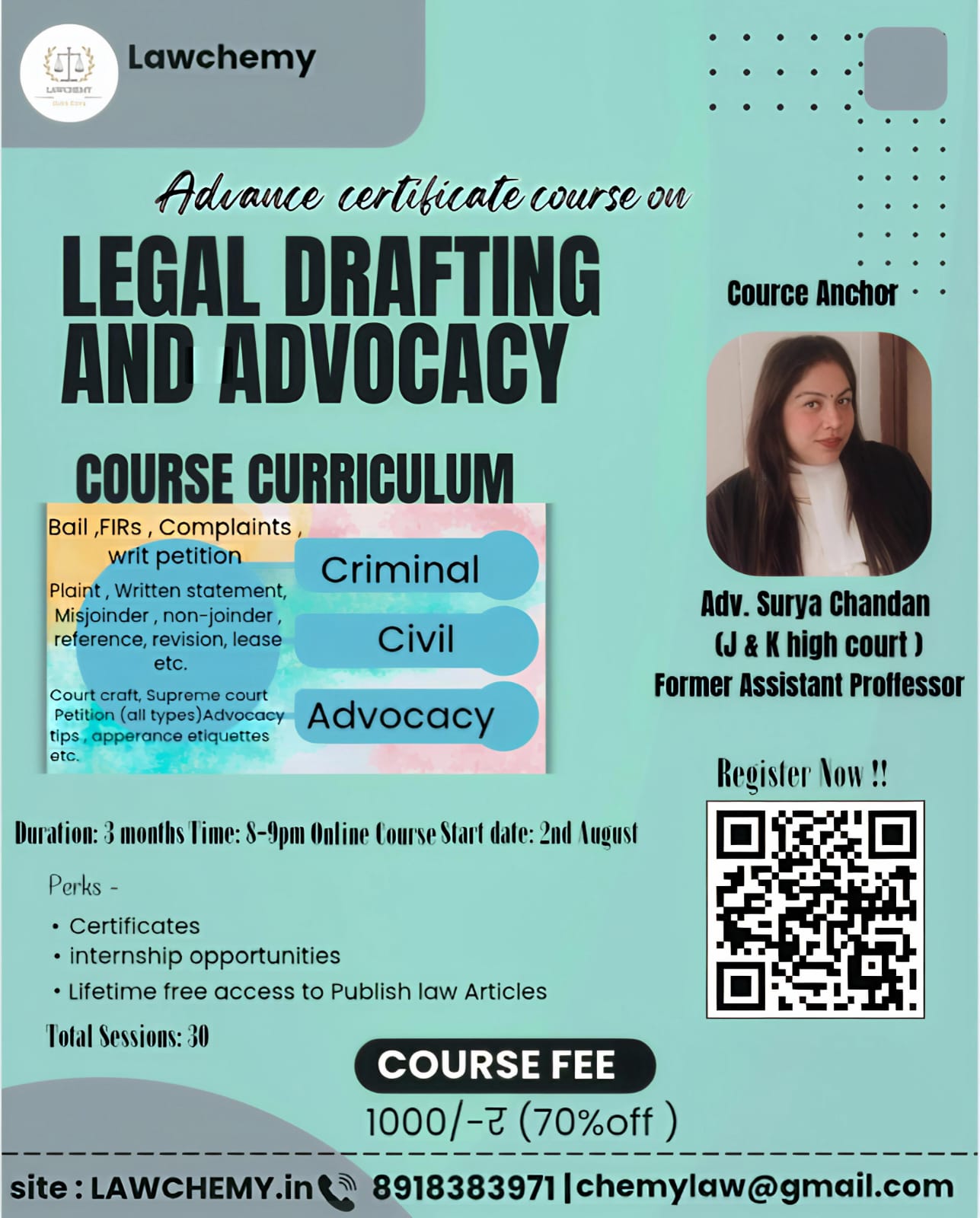
About the Course
The CERTIFICATE COURSE ON ADVANCED LEGAL DRAFTING, PLEADING AND ADVOCACY is a THREE MONRTHS COURSE designed to to teach the learners from basic to advance practical skills of Drafting covering the fundamentals of legal writing, principles of legal language and style, document structure and the creation of common legal documents Like: Contracts, Notices, Writs, Legal opinion, Pleading and Conveyancing. The course provides a comprehensive understanding of legal drafting and how to engage in hands-on exercises, case studies, and interactive sessions that bridge the gap between theory and real-world application, with two sessions each week to balance training and practical exposure . It also includes how to establish certain links, interaction with the clients and other practical exercises, case studies, and guidance on legal document review and editing.
This course includes:-
Principles of Legal Writing:
This includes understanding legal terminology, clarity, precision, and effective communication in legal documents.
Structure of Legal Documents:
Learning how to properly structure different types of legal documents, such as contracts, pleadings, and legal correspondence.
Contract Drafting:
Understanding the key elements of contracts, including clauses, negotiation, and different types of contracts.
Course Overview
This court refers to the process of preparing legally sound documents that will be presented in court. This includes a range of documents like contracts, agreements, pleadings, and many more. All requiring precise language and adherence to legal principles to ensure clarity, enforceability, and protection of the client’s interests.
Aims & Objectives
The main aim of legal drafting is to create clear, accurate, and legally sound documents that accurately reflect the intentions of the parties involved and are enforceable in a court of law. Key objectives include ensuring clarity and precision in language, achieving legal compliance, minimizing disputes, and providing a written record of agreements.
Who Should Apply?
This course is ideal for a wide range of individuals, including law students, practicing lawyers, paralegals, and even those in non-legal fields who need to understand legal documents. This includes individuals interested in litigation, civil law and criminal law as well as corporate law, or anyone seeking to improve their understanding and skills in legal writing and document creation.
What is the source of finding relevant materials
Relevant books of the author
E-Books
Sample of the draft
Suggested Websites
Recording lectures for future references
Live session course work
SCHEDULE
Duration: 3 MONTHS
Total No. of Classes: 30 (Including Orientation and Concluding Session)
Frequency: Two classes per week
Days: Saturday & Sunday
Time: 8.00 – 9.00 PM
Mode: Online (Google Meet)
PERKS
Online material
E-Certificate on Completion
Internship Opportunity
3 Years Free Access to Publish Articles with Lawchemy.
COURSE CURRICULUM
FIRST MONTH (10 classes)
CIVIL DRAFTING
Session 1: Orientation Session
Session 2: discuss hierarchy and detailing of the syllabus and various Definition of drafting and conveyancing and Basic Components of Deeds
Session 3: various form of civil plaints Will and Power of Attorney, Drafting a Will, Drafting a Power of Attorney, How to find relevant material related to preparation of case study. What is contract and important terms and conditions for signing various forms of contract? What is stamp duty and relevance of this while filing the case in the court. Time and Place of Registration, Effects of Registration and Non-registration of Documents. Adjudication and Payment of Stamp Duty. What is affidavit and how to attest affidavit from the court. What is notary and what documents are needed for attestation from the notary? what is oath commissioner? Law relating to Power of Attorney, Common opening forms for a power of attorney, power of attorney to a lawyer, power of attorney to two or more persons.
Session 4: Injuction and types of injunction suits. Court fee and execution and the Drafting of execution. Order, decree and judgement and its difference.
Session 5: Appeal in civil suit. Reference, Revision and Judicial Review.Agreement to sell. Rent agreement. Detail information to interact with client and how to find judgement and other finding in the draft.
Session 6:Specific Relief Act. Recovery of specific immovable property and its draft. Description of property how to be made, Definition, alteration and registration of Sale.
Session 7: Types of suit, Inter-pleader suit, Suit for dissolution of partnership, Suit for malicious prosecution, Suit for dissolution of interlocutory application: – Misjoinder and Non- joinder,
Session 8: Registration of firm and Its Draft and its Dissolution. Definition of Lease, Attestation and registration of lease deed, lease of a house for a term exceeding one year, rents being payable every month, Surrender of a lease by deed. Gifts how made, execution and attestation. Deed of a gift property.
Session 9: draft samples with Group discussion
Session 10: live session classes with problem –solving clearification.
2nd Month (10 classes)
CRIMINAL DRAFTING
Session 11: Criminal drafting And basic skills for drafting criminal complaints, appeals.FIR And relevance of zero FIR with relevant judgement. Charge, Group of charge And framing of charge in criminal case. Complaint and its Draft
Session 12:Bail(Bailable offence and non-Bailable offence). Arrest without warrant. Drafting of different types of bail and bail bond.
Session 13: What is single bench of judges and what is double bench with landmark judgement? What is quantum of punishment? What is fine and what is punishment and its difference? What is meaning of trial? How many types of trials
Session 14: Fast track court and it’s Origin. Juvenile matter And its cognizance. POCSO and its Basis.Petitions: Types Of Petitions. E-court, virtual hearing, challan how to pursue cases in court.
Session 15: Petition under Articles 226, 32 of the Constitution. Powers of High court and Supreme Court. PIL(Public interest litigation) with landmark judgement. Bail and its types. Draft of Bail application.
Session 16: What is Mact court and how insurance company role important in Mact case? What is legal notice and how to draft legal notice?
Session 17: Cheque bounce and Drafting of legal notice in cheque bounce case. Section 138 of Negotiable instrument Act. Hostile witness – In which cases re-examination of witness is allowed in court? Disposal of case And withdrawal of case.
Session 18: Statement of record before the police. Statement of record before magistrate and Consideration of statement in Court. General guidelines while arresting the accused in D.K Basu Case. Protest petition.
Session 19: NDPS Courts. TADA Courts, PSA Acts, POTA Courts And other relevant acts and relevant judgements.
Session 20: Doubt clearance session with GD.
3RD Month (10 classes)
ART OF ADVOCACY AND APPEARANCES
Session 21: Professional Etiquettes l Court Craft l Preparatory Points l Duty towards Court, Client and Opponent, Important Principles of Advocacy l Advocacy Tips l Prerequisites for entering appearances l Appearance Etiquettes.
Session 22: Technique of writing legal documents enhances efficiency as well as improves economies of scale. What is profession misconduct? What is the Moot court and explain the importance and relevance of moot court participation. What techniques followed while doing research work before drafting case?
Session 23; Give briefing about the various other career related option in legal field irrespective of legal practice in court. Thhe important litigation option where to get more cilentage and how to understand the factual aspects of case in first interaction and how to build trust and confidence with the client(Various follow up rules and regulation while interacted with clients).
Session 24: Various mode and techniques of increasing cilentage and earning source and establishment in legal profession.
Session 25: Quashing and Writ Petitions Quashing of FIR/Clubbing of FIR, Writ Petition under Article 226 (High Court), PIL/Writ Petition under Article 32 (Supreme Court). Appeals and Bail Applications,
Session 26: Bail Application/Anticipatory Bail Application, Appeal against Conviction, Special Leave Petition and Civil Appeals, Special Leave Petition under Article 136, Civil Appeal (Statutory Appeals and Limitation), Interlocutory Applications.
Session 27: Miscellaneous Petitions, Contempt Petition, Execution Petition, Revision Petition, Review Petition, Miscellaneous Application (Supreme Court), Curative Petition.
Session 28: Legal drafting. Types of classes provided in this course work. Live session classes, Landmark judgement explanation and outcomes.
Session 29: Group discussion. Moot court trials. Basic tools for searching relevant data. Live classes assign
ments session with feedback.
Session 30: Concluding Session
ENROLL HERE
Course Fee:1000 Rs(70% Off) Limited Time Offer
CONTACT:
8918383971
Mail: Chemylaw@gmail.com
Web: lawchemy.in
App: Lawchemy(Available on Google Playstore having extra free materials)
Socials: Lawchemy
